Showing posts with label Science. Show all posts

Saturday, February 4, 2017

Who is in Charge of the House of Science?

I was rushing, worried, scanning the house to make sure everything was in order before the new occupant arrived. I was not ready to leave, in fact did not want to leave. I worried about the children -
would these substitute parents be good to them? How could I even leave them? Would the house be cared for?

These are bits and pieces of a dream that had me tossing in my sleep last week. It was my second nighttime visit of thoughts and worries concerning the future of science after co-hosting a living room salon to discuss trust and ethics.

My dream about the transfer of responsibility to caretakers of my own house was almost certainly precipitated by an exercise I undertook from Liberating Structures to give ReImagine Science a score on how participatory our own meetings are. Turns out that in spite of our commitment to such, we aren't. Not really. Not enough.

The dream also revealed my fear of letting go of decision-making and leadership. ReImagine Science is my baby. It is something I have given my life over to. Perhaps this is shared by those I personally see as old, arrogant and powerful in science. Perhaps they too have a deep commitment to the foundational place in society for science 'done well.' We might share this concern of giving over power for something we have given our lives to that we care for very much.

Michael Faraday

This may be the same power redistribution I imagine the top leadership in science is experiencing (and resisting) right now.

Nevertheless, hosting the salon gave me clarity. The truth is that science is dying. I have been lost in contemplation over it. At times I simplistically view it as a transfer of power from the aging arbiters of policy and money in science to the swelling ranks of scientists who are trained and ready to step out of lengthy years of training (PhD, post-doc) and into their careers. But this young generation of scientists have already been abandoned by science itself at this flexion point – and they know it. But as science as we know it dies, something new is waiting to be born.

One thing is clear to me. The future of science will not be informed by the past. Can these young scientists really take over the care of the giant structure in which science is housed? And what can they know about taking care of a house that is in the process of being dismantled? If our next generation of scientists are required to succeed in the current structure, how well-equipped might they be to lead change? If not, then who will be?

This slow-burning, mounting crisis rides atop the ending of three different arcs of societal evolution. We are all caught in a mash-up of all three bursting at the seams, beginning to change all at the same time. What will this explosion look like, and where will all the bright, shiny pieces land?

First, there was the era of domination as a societal organizing principle, with men holding power, and war and destruction being the major driver of dominance.

In 'The Chalice and the Blade' Riane Eisler suggests that this current dominator model, where technology is used in service to conquering vs partnership, is maladaptive*. If the time-line suggested by current archeological evidence, as interpreted by Eisler, is correct, this era gained full footing when the equalitarian people of Crete were conquered approximately 3,500 years ago.

The second trend-line began 400 years ago. The age of reason and enlightenment drove the scientific method. We have benefited tremendously from these reductionist approaches to experiment and discovery. The idea of isolating variables, and requiring reproducible results**, lead to an age of reason, and a scientifically-grounded society. Kudos to that!

Last came the post-WWII era. Vannevar Bush married the attainment of the Ph.D with original research, and our basic research arm nested itself in the university. PhDs became our next crop of products, tied hand-in-hand with the discovery process. It has all worked beautifully, creating a very robust system for scientific and societal growth.

But the end of the ways things have previously worked seems to be coming at us, quite visibly in many cases, with workforce issues being one of the areas in nearly full breakdown. Indeed, science is no different from the majority of industries undergoing radical reboots.

~

Attention to the changing demographics in science, and the lack of empowerment of our younger generations of scientists, has been quietly shared in the public domain over the years. Here is some recommended reading on the topic:
*For an intense portrayal of how a domination model is maladaptive, the contents of the book 'Woman and Nature, the Roaring Inside Her' by Susan Griffin will sit heavily. 'Lifting the Veil, the Feminine Face of Science' by Linda Jean Shepherd, one of ReImagine Science's co-founders, is an excellent source of ideas and discoveries about the roots of our current age of reductionist approach and the idea of conquering nature as our best application of technology.
**(change is afoot in this domain as well)

Monday, December 19, 2016

Is Science Dying?


My thoughts on a recent living room salon we co-hosted with the Global CoLab Network in the Washington, D.C. area will be posted here in the next few days. 

Update:
On November 29, 2016 ReImagine Science and the Global CoLab Network co-hosted a living room salon with the attendees listed (see side-bar).  

The openness and candor of everyone in the room struck a chord with me. What I heard from the scientists in the room is that current institutions of science are not likely to take dramatic measures necessary to rescue the current generation of young PhDs. There may be hope for the future, but there is also, it seems, a desire for life to go back to a time when successes were more attainable, when there was more ready support and open doors. 

But the radical reboot needed to reimagine what we can do with our current scientifically trained Ph.D. cohorts looking for stable, palatable work that fully utilizes their breadth and depth of training and knowledge is not in the works. And I think they sense it.

Thursday, July 7, 2016

Incubating Scientists

From our website ReImagine Science:
~
We posted a question to our network of science leaders, practitioners, policy makers, and consultants.
The question:
ReImagine Science (formerly Yámana Science and Technology) is celebrating seven years of effort to assist the science and technology sectors in building a future that efficiently serves the planet, society and scientists to our highest capability.
Institutions like the National Academy of Sciences have formally identified a need to support scientists in their ability to create and maintain strongly cross-functional teams in their ‘science of team science’ study area (see http://bit.ly/sciteamsci).

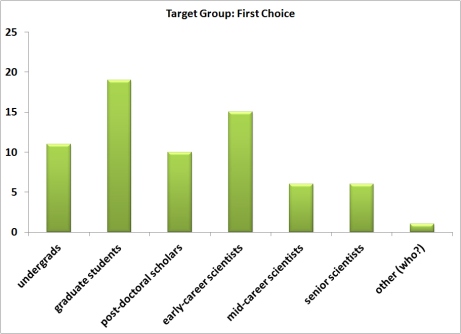
Now, under our new name of ReImagine Science, we are launching an incubator to provide the training necessary to richly engage scientists in ‘team science.’ We would like to find out from you who you think our best target participant group might be.

We then asked respondents to rank the following potential participant groups:
  1. undergraduate students
  2. graduate students
  3. post-doctoral scholars
  4. early-career scientists
  5. mid-career scientists
  6. senior scientists or
  7. other (who?)
Over 70 people responded.  This survey was not intended to be a statistically relevant assessment of the scientific community’s beliefs.  It was initiated to learn from our highly respected network, and to begin a conversation within the various universities, scientific organizations, and policy setting communities we intersect with.
The top three rankings are depicted below – graphing the choices for top rank, second, then third.

Survey results
First Choice of respondents (by category)
~
As we noted in that posting, (see it here), my impression was strongly that those who are, or who work with, scientists are easily swayed that more team-work would be a good thing for scientists -- especially those they work with!
 
Our approach from our earliest days as a 501(c)3 - when we incorporated as Yámana Science and Technology in 2008 - we have felt that change must come from within.
 
Bringing that to the most personal level, one's own framing, beliefs, unknown biases, and ability to operate amongst other humans can bring energy and excitement, or can seem, often as not, a struggle against limitations - usually theirs.
 
In this spirit, we are undertaking a small prototype using TheoryU and social presencing theater at Estes Park later this month.  
 
If you are interested in more information, please contact me kennan@reimaginescience.org


Sunday, February 24, 2013

Science Headfirst

I'm Kennan Kellaris Salinero, and I'm on a mission.

The mission is to see that science takes its best - the beauty of the discovery, our love of understanding bits and pieces of the universe, creating new capabilities in the world - and elegantly outgrows its worst - the tournament model for success, arrogance, and our attraction to pedestals (and standing on them).

Why?  Several reasons. 

I have two sisters that have chronic illnesses.  Chronic illness is on the rise in general, from what I see.   

Indeed there seem to be several mysteries on the rise..... 'out of balances' that could use an elegant understanding of the whole system.  And I suggest that many of these 'out of balances' come, unintentionally and inadvertently, from science and technology itself.  Think plastics and the Great Pacific Garbage Patch.  Who better to deal with the outcomes of science than scientists?  We have terrific opportunities to jump in a make a difference, and I see our younger generation, and passionate 'elders' of science, doing so.  But is it enough?  Fast enough, big enough, visionary enough?

Science itself, as an industry, is experiencing fairly cataclysmic stressors.  Some say we don't have enough scientists and engineers in this country, some say we have too many.  And it's likely that your mind immediately jumped to funding and the mantra "Science needs more funding."

Ok, yes, maybe, more money is always a nice thing.

But the change I'm wishing to see and help along is in the realm of 'being.'  How are we 'being' as scientists?  And what sort of 'doing' is this prompting?

Because it's in the 'doing' of science that major change is being called forth.  How do we work together?  How do we interact with society?  How do we raise our 'young' (the next generation of scientists)?  How do we teach science?  What do we study, and what do we fail to study?  What is our reward system, and what does that promote?  What do we reward?  All of these are things we are 'doing.'  And I see a huge opportunity for a major shift in the 'doing' of science.  And I think we are ready.

So I'm out here, in a space that Michael Margolis, evangelist for narratives to get work done, describes as the heretic calling back to the tribe.  I believe we, as a community have the ability to actively create how we want science to 'be.'  By learning where we really are right now, by being present to the costs of the current way of doing things, and by calling out our best vision of what we want to be.

And really, as I do this, I'm not going Headfirst so much as I'm traveling Heartfirst.  And I invite those of you ready to do so to join me in following our hearts.  And hey, we can still use our heads.  We're scientists, right?